


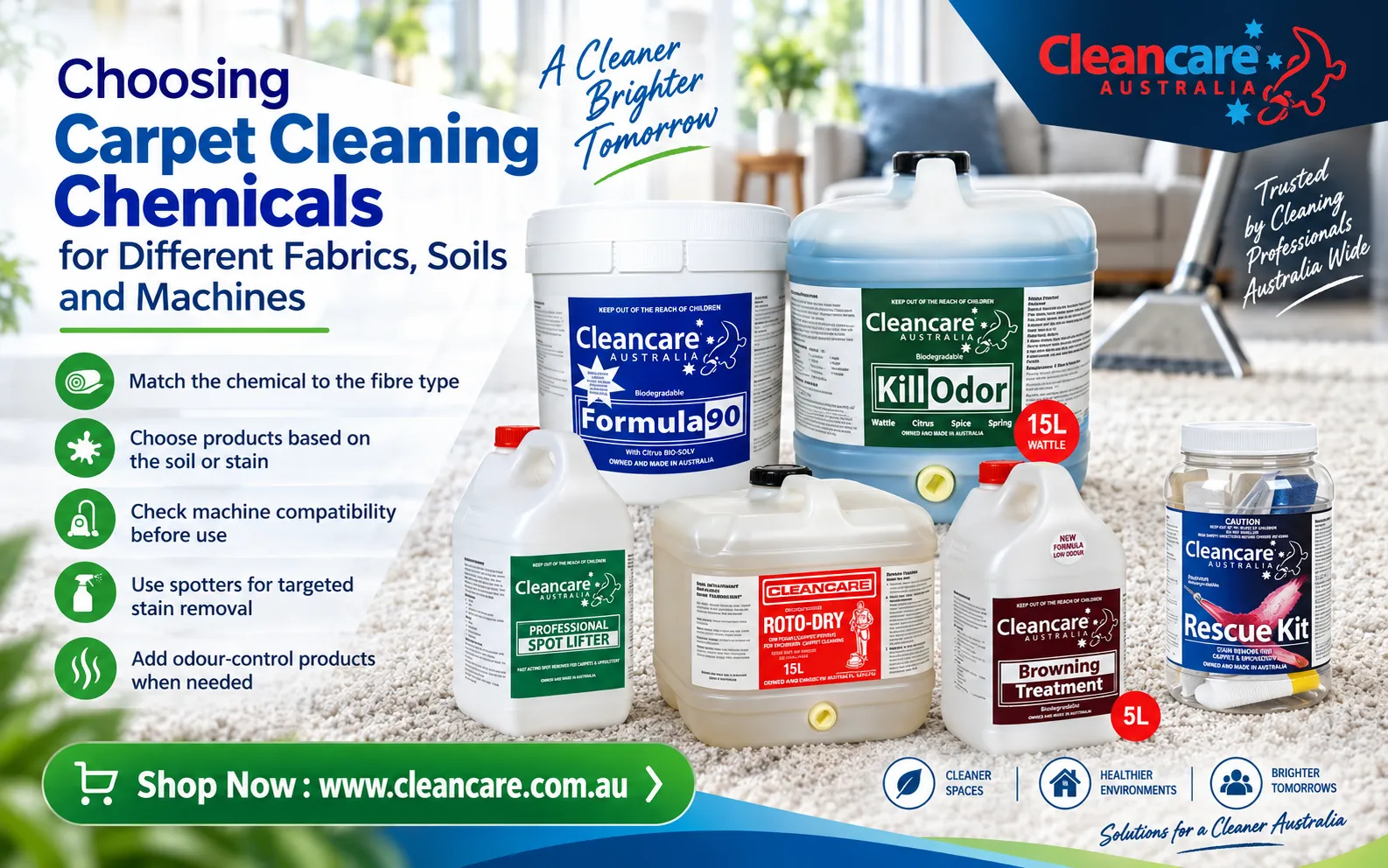
Choosing the right cleaning method can make a major difference to the appearance, feel and lifespan of carpets. However, professional-looking results do not come from a machine alone. The chemical used, the type of carpet fibre, the soil being removed and the cleaning equipment all need to work together. Selecting unsuitable products can result in poor soil removal, excessive residue, colour problems or unnecessary rework.
For professional cleaners, facility managers, property managers and homeowners, choosing the right carpet cleaning chemicals starts with understanding what is actually being cleaned. A heavily trafficked synthetic carpet in a commercial building may require a completely different approach from a delicate rug, residential carpet or upholstery fabric. Cleancare Australia provides a broad range of carpet chemicals, including detergents, pre-sprays, spotters, stain removers, deodorisers, rinse chemicals, encapsulation products and other carpet-care solutions.
Why Chemical Selection Matters in Carpet Cleaning
A carpet is not one uniform material. Different fibres react differently to moisture, agitation, heat and cleaning agents. Soil can also vary significantly.
A carpet may contain:
-
Dry particulate soil such as dust and sand
-
Oily or greasy residues
-
Food and beverage spills
-
Pet-related contamination
-
Body oils and everyday traffic soil
-
Sticky residues
-
Old stains
-
Odour-causing contamination
A successful cleaning process therefore requires more than choosing a product labelled “carpet cleaner.” The cleaner needs to consider the fibre, construction, soil load, cleaning method and machine.
The right chemical can help loosen and suspend soil so that the cleaning equipment can remove it efficiently. The wrong chemical, on the other hand, may not be suitable for the fibre or equipment and can make the cleaning process more difficult.
Start by Identifying the Carpet Fibre
Before choosing a chemical, identify the material being cleaned wherever possible.
Synthetic Carpets
Synthetic fibres such as nylon, polypropylene and polyester are widely used in homes, offices and commercial environments. They are generally selected for durability and practicality, but this does not mean every chemical or cleaning method is automatically suitable.
Heavy-traffic synthetic carpets may need stronger soil-removal processes, while lighter residential carpets may require a more controlled approach.
Wool and Natural Fibres
Wool and other natural fibres require greater care. Temperature, moisture, agitation and chemical selection should all be considered carefully.
For these materials, always follow the carpet manufacturer’s care instructions and the chemical manufacturer’s directions. Testing an inconspicuous area before broader application is a sensible precaution.
Rugs and Speciality Textiles
Rugs can contain different fibres, backing materials, dyes and construction methods. A product suitable for a standard wall-to-wall synthetic carpet should not automatically be assumed to be suitable for every rug.
This is one reason Cleancare maintains separate categories for carpet chemicals and rug cleaning chemicals, allowing users to select products according to the application.
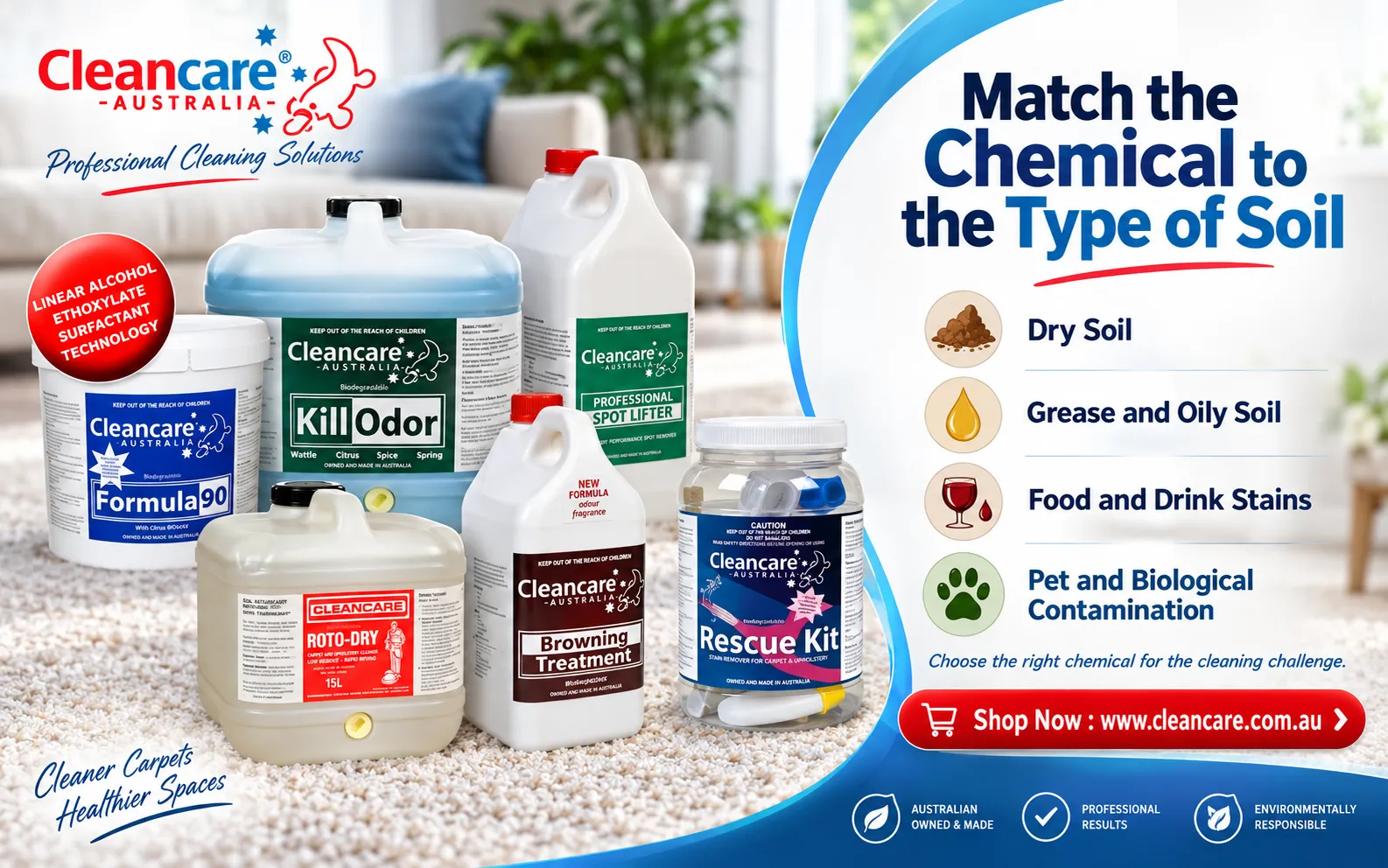
Match the Chemical to the Type of Soil
Once the fibre is identified, consider what needs to be removed.
Dry Soil
Dry soil is usually handled first through thorough vacuuming. Removing loose particles before wet cleaning reduces the amount of material that the chemical and machine have to deal with.
Grease and Oily Soil
Commercial carpets around entrances, kitchens, offices and hospitality areas can accumulate oily residues. These soils may require a suitable pre-spray or detergent designed for the cleaning method.
Pre-treatment gives the cleaning chemical time to work on embedded soil before extraction or agitation.
Food and Drink Stains
Coffee, tea, wine, soft drinks and food can create both visible stains and sticky residues. A general detergent may not always be the most appropriate solution for a specific spot.
This is where dedicated spotters and stain removers can become useful as part of a controlled cleaning system.
Pet and Biological Contamination
Pet urine and other biological contamination can require specialised treatment. Odour control should not simply mean covering the smell with fragrance. The contamination should be addressed using an appropriate product and process.
Cleancare offers dedicated urine and odour-control products in addition to general carpet chemicals.
Choose the Chemical According to the Cleaning Machine
The machine is another important part of the equation.
Different equipment uses different application and recovery methods, so the chemical must be compatible with the intended process.
|
Cleaning Method |
Typical Application |
Important Considerations |
|
Hot water extraction |
Pre-spray + rinse/extraction |
Soil suspension, extraction and residue control |
|
Portable extraction |
Residential and commercial carpet cleaning |
Solution compatibility and recovery |
|
Dry/bonnet cleaning |
Lower-moisture applications |
Suitable detergent and pad/bonnet compatibility |
|
Encapsulation |
Interim and low-moisture cleaning |
Polymer-based encapsulation process |
|
Spot cleaning |
Small stains and problem areas |
Targeted spotter and controlled application |
Cleancare’s equipment range includes portable and steam carpet-cleaning machines, commercial carpet-cleaning machines, carpet and upholstery machines, encapsulation machines and other cleaning equipment.
This matters because the chemical should be selected with the equipment and cleaning method in mind rather than purchasing products independently of the machine.
Pre-Sprays: Preparing the Carpet Before Extraction
Pre-spray is often an important part of professional carpet cleaning.
Instead of expecting the extraction machine to remove every type of soil immediately, a pre-spray can be applied to help loosen embedded contamination before agitation and extraction.
Cleancare currently lists a dedicated carpet pre-spray category, including products such as Prekleen Enzyme Carpet Cleaning Pre-Spray & Powder Detergent and Prekleen Carpet Pre-Spray Refill.
A sensible pre-spray process generally involves:
-
Vacuuming thoroughly.
-
Applying the appropriate pre-spray.
-
Allowing the product to dwell according to its instructions.
-
Agitating where appropriate.
-
Extracting with the correct machine and rinse system.
-
Checking the finished carpet after cleaning and drying.
The exact process should always follow the manufacturer’s product directions and the carpet manufacturer’s recommendations.
Carpet Detergents and Extraction Cleaning
For extraction cleaning, the detergent and rinse system need to work together.
A good cleaning system aims to loosen soil, suspend it and remove it effectively through extraction. Excess chemical residue can potentially contribute to rapid resoiling, which is why correct dilution and appropriate rinsing are important.
Cleancare’s current range includes products such as Formula 90 Heavy Duty Carpet Cleaning Powder Detergent, Formula 90 refill products and Roto-Dry Dry Carpet Cleaning Detergent.
These products demonstrate an important principle: different cleaning methods call for different chemical solutions.
Dry and Low-Moisture Carpet Cleaning
Not every carpet-cleaning job requires the same amount of water.
Dry or low-moisture cleaning can be useful in situations where rapid drying is important, such as some commercial environments or areas that need to return to service quickly.
Cleancare lists dry carpet cleaning products, accessories and equipment alongside traditional extraction solutions. Its product categories include dry/bonnet carpet cleaning and carpet encapsulation chemicals.
The key is to select the chemical specifically intended for the chosen cleaning system. Using a conventional extraction detergent in an unrelated low-moisture process may not provide the expected result.
Encapsulation Cleaning for Maintenance Programs
Encapsulation cleaning is another option for maintaining carpets between deeper restorative cleans.
The process generally involves applying a suitable encapsulation product, working it into the carpet and allowing the encapsulated soil to be removed through subsequent vacuuming.
This can be particularly useful as part of a planned maintenance programme where carpets experience regular traffic.
Cleancare currently lists dedicated encapsulation carpet chemicals as well as encapsulation carpet-cleaning machines.
What About Spotters and Stain Removers?
A general carpet detergent should not be expected to solve every individual stain.
A targeted spotter can be more appropriate for isolated contamination, especially when a stain needs additional attention before or after the main cleaning process.
Cleancare lists a dedicated carpet spotters and stain removers category with 21 items, including products such as Professional Spotlifter and Rescue Kit Stain Remover.
However, stain removal should always be approached carefully. Different dyes and fibres can react differently, so product instructions, testing and controlled application are essential.
Defoamers, Deodorisers and Other Supporting Chemicals
Carpet cleaning is not limited to detergent.
Depending on the equipment and condition of the carpet, additional products may be required.
Defoamers
Foam can interfere with recovery equipment and cleaning performance. Cleancare provides a dedicated carpet defoamer category as part of its carpet chemical range.
Deodorisers
After cleaning, some carpets may still have unpleasant odours caused by pets, spills, smoke or other contamination. A suitable deodoriser can form part of the finishing process.
Protectors
Carpet protection products can also be used where appropriate to help maintain treated surfaces after cleaning.
Cleancare lists carpet and upholstery protector chemicals alongside detergents, spotters, deodorisers and rinse products.
A Simple Selection Guide for Cleaners
The following framework can make chemical selection more systematic:
|
Situation |
What to Consider |
Potential Product Category |
|
Heavy traffic carpet |
Fibre, soil level and dwell time |
Pre-spray + detergent |
|
Food or drink stain |
Type of stain and fibre |
Spotter/stain remover |
|
Pet odour |
Source and contamination |
Urine/odour control |
|
Routine maintenance |
Cleaning frequency and traffic |
Encapsulation or low-moisture solution |
|
Dry cleaning |
Machine and pad/bonnet method |
Dry carpet detergent |
|
Extraction cleaning |
Machine and rinse system |
Carpet detergent + rinse |
|
Odour after cleaning |
Cause of odour |
Carpet deodoriser |
|
Excessive foam |
Machine recovery behaviour |
Defoamer |
The table is a starting point rather than a substitute for the manufacturer’s instructions or carpet manufacturer’s specifications.
Safety and Product Handling Should Come First
Professional results should never come at the expense of safe chemical handling.
Before using any cleaning chemical, check:
-
Product label and directions
-
Recommended dilution
-
Application method
-
Suitable surfaces and fibres
-
Required personal protective equipment
-
Safety Data Sheet
-
Storage requirements
-
Ventilation requirements
-
Machine compatibility
Cleancare provides an SDS section as part of its online resources, helping customers access product safety information.
Never assume that increasing chemical concentration will automatically improve cleaning performance. More products can create additional residue and may increase the risk of an unwanted reaction with a sensitive material.
Why Choose Cleancare Australia?
For professional cleaners and businesses, having access to a broad selection of compatible products can make purchasing and job preparation easier.
Cleancare is a 100% Australian-owned and operated cleaning-supply business that states it has been operating since 1972. Its range covers both domestic and commercial requirements.
The company supplies:
-
Carpet cleaning chemicals
-
Carpet detergents
-
Pre-sprays
-
Spotters and stain removers
-
Deodorisers
-
Rinse chemicals
-
Encapsulation chemicals
-
Carpet and upholstery protectors
-
Defoamers
-
Rug cleaning chemicals
-
Carpet cleaning equipment
-
Accessories and spare parts
-
Commercial and industrial cleaning supplies
-
Equipment hire
For cleaning companies and other regular commercial buyers, Cleancare also offers trade pricing and bulk supply options across its range.
That broader selection can be valuable when a business needs both consumables and equipment rather than sourcing every component from different suppliers.
Building a Better Carpet Cleaning System
The most effective cleaning results usually come from a complete process rather than a single “powerful” chemical.
Think of the job as a sequence:
Identify → Vacuum → Pre-treat → Agitate → Clean → Extract → Rinse → Dry → Inspect → Protect
The precise steps can vary according to fibre, soil, equipment and product instructions, but the principle remains the same: every stage should support the next.
A good cleaning chemical should work with the machine, not against it. A suitable detergent should complement the fibre. A stain remover should address the particular contamination. And a deodoriser should be used for the appropriate purpose rather than simply hiding an unresolved problem.
Final Thoughts
Choosing the right carpet cleaning solution is ultimately about matching the chemistry to the material, soil and cleaning equipment. There is no universal product that is ideal for every carpet, every stain and every machine. Professional results come from understanding the surface, selecting an appropriate product category and following a controlled cleaning process.
For cleaners and businesses operating in Australia, Cleancare provides a broad ecosystem of carpet cleaning products, equipment, accessories and supporting solutions. Its current range includes 54 carpet-cleaning chemical products, alongside dedicated categories for pre-sprays, spotters, deodorisers, defoamers, rinse chemicals, encapsulation products and carpet protectors.
Whether the job involves routine residential maintenance, commercial carpet restoration, hospitality cleaning or regular professional contracts, careful product selection can improve consistency and help avoid unnecessary trial and error. For the best outcome, always identify the fibre and soil first, choose a compatible cleaning method, follow the product label and SDS, and use equipment and chemicals as part of one complete system.
